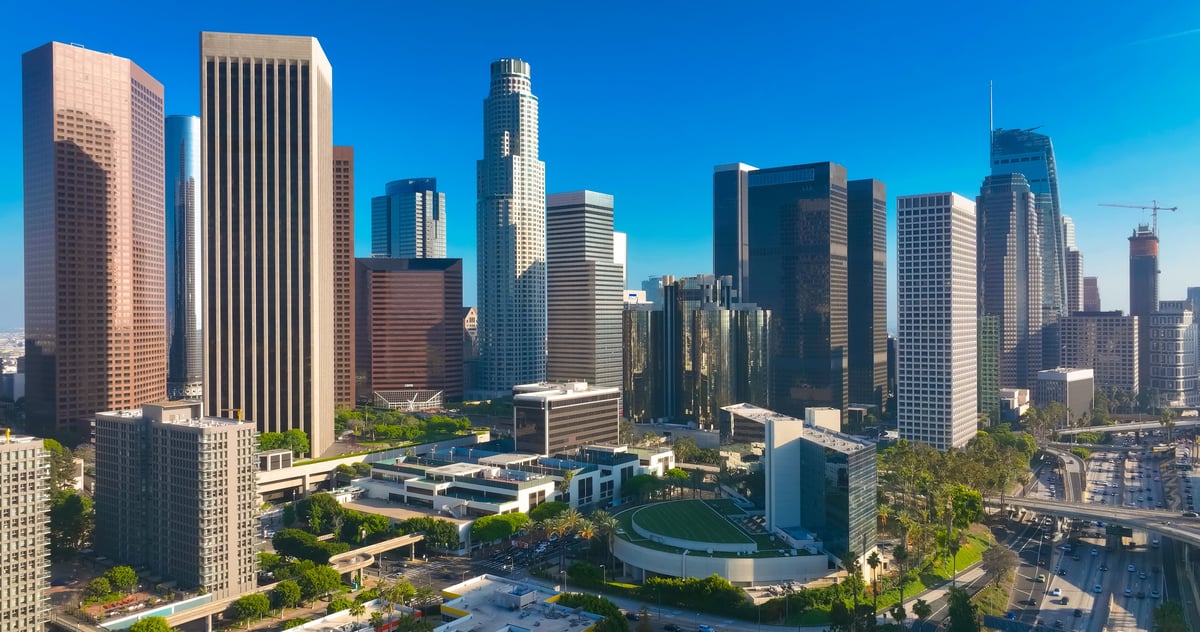
Los Angeles city. LA downtown aerial view. Los Angeles skyline. LA streets. Los Angeles from a top view. Downtown towers of Los Angeles. Panoramic scene of LA skyline. Blue sky frames the city below
HomeCitiesLos Angeles

Google Business Profile Marketing for Los Angeles Realtors Real Estate Marketing in Los Angeles — Built for Agents Who Know Which City the House Is Actually In.

Los Angeles is not one market. It is a single city made of roughly ninety named places — and it is surrounded by eighty-some separate cities that share the same mail, the same freeway, and half of the same reputation. Silver Lake, Highland Park, Venice, Studio City, Westchester, Woodland Hills: all inside the City of Los Angeles. Santa Monica, Beverly Hills, Pasadena, Burbank, Glendale, Long Beach: all their own cities with their own city halls and their own listing inventory. Buyers here know the difference to the block. Google does too. If your Google Business Profile blurs that line, the buyer reads it as a signal that you work somewhere else.

275+ 5-Star Google Reviews

Los Angeles Market Snapshot

City Population ~3.9M
LA County ~9.6M across 88 incorporated cities plus unincorporated county
Key Buyer Profile Entertainment and creative industries, tech and healthcare professionals, international buyers, multigenerational families, Valley and Westside move-ups
Peak Season March–September
Unique Factor Search intent is geographic precision — buyers shop a named place, not a metro
Why Google Business Profile Matters in Los Angeles

"Los Angeles" Is a Mailing Address. Buyers Search a Named Place.

People say they live in LA when they live in Culver City. They say they are moving to LA when they mean Pasadena. But when those same people search, they type the name of an actual place — Santa Monica, Westchester, Silver Lake, Pasadena. That is why a Santa Monica agent and a Westchester agent can be four miles apart, both describe themselves as LA realtors, and rarely show up in the same results. Buyers search by named place, so your profile should name the right places.

Inside the City of Los Angeles the problem simply changes shape. The city is enormous and officially organized into dozens of recognized neighborhoods — Silver Lake, Highland Park, Echo Park, Venice, Westchester, Studio City, Sherman Oaks, Woodland Hills, Encino, Brentwood, West Hills, Chatsworth — each with a genuinely different price band, housing type, and buyer. A profile that says "serving Los Angeles" is competing with thousands of other profiles saying exactly that. A profile that says "Highland Park craftsman and Silver Lake hillside" is competing with almost nobody.

Then there is the part most agents get wrong by accident: naming a separate city as if it were a neighborhood. Writing "serving Santa Monica, Beverly Hills, and Pasadena" on a Los Angeles profile is not a growth tactic — it reads as a mismatch to the buyers who live in those cities. The honest version works better anyway: state the city you are in, name the neighborhoods inside it, and describe the adjacent cities accurately as adjacent cities.

Get Your Los Angeles Google Business Profile Strategy

What LA Buyers and Sellers Search on Google & AI Tools

silver lake realtor
highland park craftsman homes for sale
venice canal home agent
studio city real estate agent
westchester los angeles homes near lax
woodland hills realtor ranch home
is santa monica part of los angeles
chatgpt best neighborhood in la for families

AI search is even less forgiving about geography. Ask an AI assistant "which neighborhood in Los Angeles is best for a family" and it pulls from structured profile data and review language that names real places. A profile that lists Santa Monica, Beverly Hills, and Pasadena as though they were Los Angeles neighborhoods gives the model contradictory input, and vague geography makes it harder for you to be the answer.

City of Los Angeles Neighborhoods

Six Parts of the City of Los Angeles, Grouped the Way Buyers Shop Them

Everything below sits inside the City of Los Angeles. They are grouped because buyers cross-shop within them, and each pair attracts a different price band, housing type, and search pattern.

Silver Lake & Echo Park

The hillside east-side core — 1920s Spanish and Craftsman bungalows, mid-century modern hillside homes, and small-lot infill, wrapped around the reservoir and the lake. Buyers here are creative-industry and tech professionals who know the specific streets and shop by architectural style as much as by price. Steep lots, stairs-only access, and permit history are routine parts of the conversation.

'Silver Lake realtor,' 'Echo Park bungalow,' 'Silver Lake hillside mid-century'

Highland Park & Eagle Rock

Northeast LA along Figueroa and York, plus the Eagle Rock hillside west of it. Concentrated Craftsman and Spanish stock from the 1910s and 1920s, a walkable commercial strip, and the most direct comparison set for buyers priced out of Silver Lake. Eagle Rock borders Glendale and Pasadena, so boundary questions come up constantly here — a good reason to be precise in writing.

'Highland Park craftsman,' 'Eagle Rock homes for sale,' 'York Boulevard realtor'

Venice & Mar Vista

Venice sits inside the City of Los Angeles — its canals, walk streets, and Abbot Kinney corridor included — while Santa Monica begins a few blocks north. Mar Vista and Palms next door are the more attainable westside comparison. Buyers here ask about short-term rental rules, coastal insurance, and whether a specific address falls inside the Venice Specific Plan.

'Venice canal home,' 'Mar Vista realtor,' 'Venice walk street house'

Studio City & Sherman Oaks

The south San Fernando Valley side of the hill, inside the City of Los Angeles. Mid-century ranches and traditional two-stories, hillside view homes south of Ventura Boulevard, and a steady stream of entertainment-industry buyers who want the Valley side of the hill without leaving the city. Ventura Boulevard addresses and hillside vs. flats pricing are the recurring distinctions.

'Studio City real estate agent,' 'Sherman Oaks hillside home,' 'south of Ventura Blvd'

Westchester & Playa del Rey

The LAX-adjacent westside, inside the city. Westchester holds mid-century tracts, the Loyola Marymount area, and a sizable share of LA's airport- and aerospace-linked households; Playa del Rey adds bluff-top and lagoon-adjacent condos. Aircraft noise contours, redevelopment history, and hillside-versus-flats distinctions all get asked about directly, which makes plain factual answers unusually valuable here.

'Westchester homes near LAX,' 'Playa del Rey condo,' 'Westchester realtor 90045'

Woodland Hills & West Hills

The western San Fernando Valley, inside the city. Larger lots, ranch homes, and the Warner Center corridor's newer residential development, with West Hills reaching toward the Chatsworth hills. This is where buyers trade lot size for a longer commute — and where the "is this LA or is this the Valley" question gets asked most often, even though the answer is simply yes.

'Woodland Hills ranch home,' 'West Hills realtor,' 'Warner Center condo'

The landmarks that anchor Los Angeles search

Griffith Observatory — the park and landmark that anchor Los Feliz and the east side
LAX — drives the entire Westchester and Playa del Rey search pattern
The Getty — the westside reference point between Brentwood and the Sepulveda Pass
Ventura Boulevard — the corridor that organizes Studio City and Sherman Oaks search
Warner Center — the Woodland Hills employment core
Venice Beach Boardwalk — the name most westside buyers actually type
Dodger Stadium — anchors the Echo Park and Elysian Valley edge
The 405 and 101 — freeway proximity shapes how buyers describe their own searches

Separate cities we do not fold into Los Angeles

These are all commonly called "LA" in conversation, and all of them are their own incorporated cities with separate city governments, separate local search results, and their own listing inventory. We name them accurately as neighboring cities, never as Los Angeles neighborhoods — because a buyer who lives in one of them will catch the error immediately.

Santa Monica separate city
Beverly Hills separate city
Pasadena separate city
Burbank separate city
Glendale separate city
Long Beach separate city

Also separate cities, and just as commonly mislabeled: Culver City, West Hollywood, Manhattan Beach, Redondo Beach, Torrance, Carson, Inglewood, El Segundo, Hawthorne, Gardena, Compton, and the whole San Gabriel Valley. If you actually work in one of these cities, add it to your service area and describe it as the separate city it is.

Nearby Markets We Also Serve

Alongside Los Angeles, we also serve Anaheim and Oxnard.

How the Los Angeles Market Actually Behaves

There is no "LA median." There is a beach market, a hillside market, a Valley market, and an east-side bungalow market, each with its own price band, its own commute math, and its own vocabulary — and buyers shop them one at a time.

Who's Buying

  • • Entertainment and creative-industry professionals
  • • Tech, healthcare, and aerospace households
  • • International buyers, particularly from Asia and the Middle East
  • • Multigenerational families consolidating into one property
  • • Valley and Westside move-ups trading distance for space

Seasonality

  • • Peak: March–September, stretched by the school calendar
  • • Secondary bump: January–February, relocation and new-year listings
  • • Slowest: late November through the first week of January
  • • Awards-season weeks visibly shift showing traffic on the westside

Local Quirks

  • • City boundary confusion is the single biggest source of bad leads
  • • Fire-zone and brush-zone disclosures on hillside properties
  • • Rent-control and eviction rules on multifamily and older units
  • • Short-term rental ordinances differ sharply by neighborhood
  • • Hillside grading, slope, and street-access questions on canyon lots

Search Behavior

  • • Buyers search the neighborhood name and nothing else
  • • "Is X part of LA" is a real query pattern worth answering
  • • Commute-to-work searches drive Valley and westside comparisons
  • • Spanish, Korean, Mandarin, and Tagalog searches are all meaningful channels
The Boundary Problem

Two Buyers Both Say "Los Angeles." Only One Is Inside the City.

The first buyer is looking at a 1920s Spanish bungalow in Highland Park and a hillside mid-century in Silver Lake. Both are in the City of Los Angeles. They want an agent who knows Craftsman foundations, steep street access, and the difference between an original 1925 kitchen and a flipped one. They will search "Highland Park realtor" and never type "Los Angeles" once.

The second buyer says they want to live in LA and means a condo in Santa Monica. That is a different city, a different local pack, a different set of listing rules, and a different agent. If your profile markets both identically, the Highland Park buyer sees an agent who might be based in Santa Monica, and the Santa Monica buyer sees an agent who is clearly not based in Santa Monica. Naming your actual city and your actual neighborhoods is not a limitation — it is the only thing that makes you legible to either buyer.

Silver Lake Highland Park Venice Studio City Westchester Woodland Hills
The LA Playbook

Eight Moves That Turn a Generic LA Profile Into a Local One

In a metro this saturated, specificity is the only real differentiator. Every one of these is a precision move, not a volume move.

1. Use neighborhoods inside the city, never separate cities as if they were neighborhoods

Silver Lake, Highland Park, Echo Park, Venice, Mar Vista, Westchester, Playa del Rey, Studio City, Sherman Oaks, Woodland Hills, West Hills, Brentwood, Encino, Los Feliz. These are inside the City of Los Angeles. Santa Monica, Beverly Hills, and Pasadena are not. Getting this wrong is the fastest way to lose credibility with a buyer who actually lives here.

2. Lead with property type, not adjectives

"1920s Spanish and Craftsman bungalows on the east side, mid-century hillside homes, and Valley ranches" tells a buyer something in six seconds. "Luxury real estate in Los Angeles" tells them nothing, and so does every competitor's profile. LA buyers shop architecture and lot type. Say which ones you actually sell.

3. Post photos that could not be any other city

A Silver Lake hillside stair street. A Highland Park craftsman porch. The Venice canals. Ventura Boulevard at dusk. Palms spelling out a neighborhood name. Skyline shots and beach stock photos are the two images every single LA competitor already uses.

4. Ask reviewers for the neighborhood and the obstacle

"Found us a Highland Park craftsman after four months of losing bids" or "walked us through the hillside fire-zone disclosure on a Studio City property" is worth more than fifty anonymous five-star ratings. Specific reviews attach your name to a real place and answer a real objection at the same time — which is exactly what AI models quote.

5. Split services by the buyer you actually serve

East-side bungalow buyers, westside condo buyers, Valley move-ups, hillside and canyon properties, and international buyers are five different offers with five different questions. Written as separate services with separate language, each one can match a narrow search instead of competing in the generic "Los Angeles realtor" pool.

6. Be honest about commute math

The single most useful piece of content an LA agent can publish is how long it actually takes to get from a given neighborhood to a given employment center at 7:45 on a Tuesday — the Studios, downtown, the Westside tech corridor, LAX, Warner Center. Commute reality is the deciding factor for most out-of-area buyers, and almost nobody addresses it plainly.

7. Treat multilingual content as a real channel

Los Angeles is one of the most linguistically diverse cities in the world. Spanish, Korean, Mandarin, Cantonese, and Tagalog all carry meaningful transaction volume, and a buyer searching in their own language responds differently to a profile written in it. Natively written posts and service descriptions reach households that an English-only profile simply does not speak to.

8. Answer the "is this really LA" question out loud

Thousands of people search variations of "is Santa Monica part of Los Angeles" or "is Burbank in LA County" every month. Answering it accurately — with a plain explanation of which places are the city and which are separate municipalities — earns trust, earns citations from AI tools, and quietly demonstrates that you understand the terrain better than the agent who blurred it.

In a metro of ten million, precision beats reach.

Nobody wins Los Angeles. Agents win Silver Lake, or Westchester, or Woodland Hills, and then add the next one from a position of strength. The profile that names the right places, the right property types, and the right questions stops being one of thousands of LA realtors and starts being the answer for a specific buyer standing on a specific street.

Los Angeles Real Estate FAQ

Questions LA Agents Ask About Google Business Profile

Straight answers for agents working the east side, the westside, and the San Fernando Valley — and for agents trying to figure out which city they are actually marketing in.

Have a question that isn't here about Los Angeles or your specific part of the city?

Schedule a Free Los Angeles Strategy Call

Ready to Get Found in Los Angeles Search?

Book your free 30-minute strategy call. We'll audit your current visibility and show you exactly how to get more leads from Google Maps.